

 My GIA Now
Resolving Customs Clearance Delay at New Delhi Airport
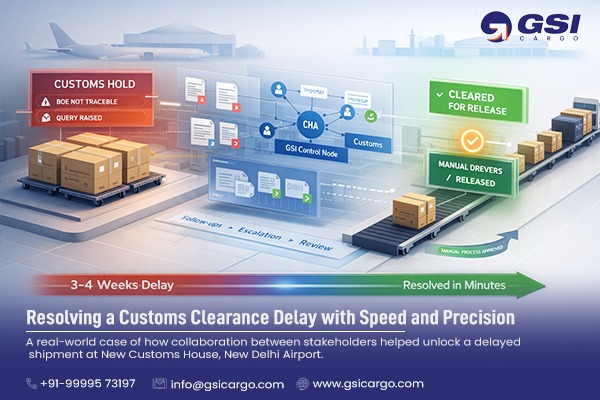
Resolving a Customs Clearance Delay at New Delhi Airport through Collaboration and Practical Decision-Making
Overview
Background
- Shipment Type: Lighting equipment
- Location: New Customs House, New Delhi Airport
- Stakeholders Involved:
- Importer
- CHA (Custom House Agent)
- Customs Department Officials
Problem Statement
- Bill of Entry / shipment details not traceable in the system
- System-generated queries regarding non-payment
- Request for re-examination of shipment
- Misalignment between system data and actual transaction terms
Root Cause Analysis
- Shipment-related documents were not visible on the portal
- Payment terms were based on a 60-day credit agreement, hence no immediate bank proof was available
- Queries were raised based on system limitations rather than actual discrepancies
Contributing Factors:
- Lack of early identification of the technical issue
- Limited communication between stakeholders
- Dependency on system visibility for decision-making
Challenges Faced
- Multiple visits and repeated follow-ups by CHA and importer
- Increasing time and operational cost
- Confusion due to overlapping queries
- Difficulty in explaining technical issues across stakeholders
Intervention & Resolution
After several rounds of discussions and internal reviews, the issue was escalated for higher-level intervention.
Key Actions Taken:
- Identification of the technical glitch with support from the CHA and team members
- Escalation of the case to senior customs officials
- A focused discussion with decision-makers
Critical Turning Point:
During a brief meeting, Ms. Bharti acknowledged the possibility of a system issue and recommended manual processing of the case.
Additionally, Officer Veena played a supportive role in ensuring smooth coordination and practical handling of the matter.
Outcome:
- Resolution provided within 5–10 minutes of the meeting
- Clearance process resumed immediately
- Delay of several weeks resolved through a single decision
Results & Impact
Quantifiable Impact:
- Reduced further delay and prevented additional costs
- Eliminated need for repeated visits and follow-ups
Qualitative Impact:
- Improved coordination between stakeholders
- Reinforced trust in the customs process
- Demonstrated flexibility within the system
Key Learnings
Importance of Early Root Cause Identification
Delays can be minimized if technical issues are identified at an early stage.
Collaboration is Critical
Alignment between importer, CHA, and customs officials is essential for efficient resolution.
Role of CHA as a Bridge
CHA plays a crucial role in interpreting issues and facilitating communication.
System Dependency vs Practical Judgment
While systems are important, human judgment and flexibility can accelerate resolution.
Need for Clear Communication
Misunderstandings often arise due to lack of clarity rather than lack of intent.
Best Practices Going Forward
- Conduct early validation of document visibility in the system
- Encourage proactive communication among all stakeholders
- Escalate cases promptly when repetitive queries arise
- Develop analytical capability within teams to identify root causes
- Promote a solution-oriented approach rather than procedural rigidity
Conclusion
This case highlights that customs clearance challenges are not always due to regulatory barriers but often arise from system limitations and communication gaps.
The swift resolution driven by Ms. Bharti and supported by Officer Veena demonstrates how practical decision-making and collaborative effort can transform delays into efficient outcomes.
Ultimately, this case reinforces a key insight:
When stakeholders work together with clarity and intent, even complex challenges can be resolved quickly and effectively.