

 My GIA Now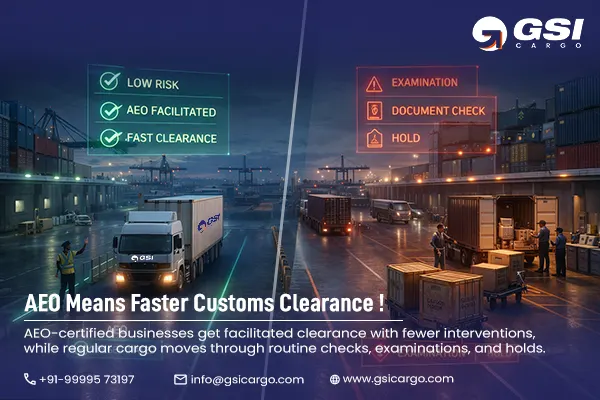
Why Was the AEO Programme Introduced?
With the rapid and continuous growth of global trade, customs administrations worldwide face a fundamental challenge:How can security and compliance be ensured without physically scrutinizing every shipment at the border?Expanding manpower or infrastructure indefinitely is neither practical nor cost-effective. To address this, customs authorities globally adopted a risk-based approach, identifying and trusting businesses that consistently follow ethical, transparent, and compliant business practices.The AEO Programme was designed to:- Reduce border risks
- Strengthen supply chain security
- Facilitate faster and predictable customs clearance
Core Philosophy of the AEO Programme
The AEO framework operates on the principle that most businesses are compliant by design. Companies that can demonstrate strong internal controls, documented processes, and regulatory discipline are treated as low-risk trade partners.Key parameters evaluated under AEO include:- Ethical business conduct
- Robust internal controls
- Effective risk-management systems
- Secure handling of cargo and data
- Compliance with Customs, GST, and allied laws
- Transparent and accountable decision-making processes
Process Discipline & Documentation
For logistics companies, importers, exporters, warehouse operators, and customs brokers, AEO compliance requires structured operational discipline, including:- Clearly defined Standard Operating Procedures (SOPs)
- Auditable cargo-handling workflows
- Secure IT systems and data-protection practices
- Formal agreements with vendors, customers, and employees
- Defined escalation and grievance-resolution mechanisms
- Regular internal audits and process reviews
Security & Anti-Terrorism Focus (Important Clarification)
A critical clarification worth emphasizing:The primary objective of the AEO Programme is NOT customs valuation or revenue collection.The core global objectives of the programme are:- Supply-chain security and anti-terrorism safeguards
- Trade facilitation through faster and smoother customs clearance
- Smuggling
- Terror-financing activities
- Cargo tampering
- Supply-chain security breaches
How AEO Improves Turnaround Time (TAT)
For AEO-certified importers and exporters, customs clearance becomes faster, predictable, and more efficient.Key facilitation benefits include:- Direct Port Delivery (DPD)
- Direct Port Entry (DPE)
- Reduced examination and scanning
- Priority assessment and clearance
- Minimal customs intervention
- Faster cargo evacuation
Voluntary Membership with High Accountability
AEO certification is voluntary, but it carries high accountability standards.During application, businesses must:- Disclose their complete business model
- Explain end-to-end operational workflows
- Demonstrate past compliance history
- Accept audits, validations, and inspections
- Duty was underpaid, or
- Invoice value was incorrectly declared
AEO Tiers in India (As per CBIC)
India follows a tiered AEO structure based on compliance maturity and risk profile:AEO-T1
- Entry-level certification
- Basic facilitation benefits
- Faster clearance
AEO-T2
- Enhanced facilitation
- Eligibility for deferred duty payment
- Greater procedural relaxations
AEO-T3
- Highest trust category
- Maximum facilitation
- Priority across customs processes
Deferred Duty – Explained Simply
Deferred duty works on a principle similar to GST compliance:- Businesses collect GST from customers
- Payment is made later through periodic returns
- Clear cargo immediately
- Pay consolidated customs duty at a later stage
Government’s Risk-Based Trust Model
Customs authorities continuously assess:- Compliance track record
- Financial stability
- Volume and consistency of trade
- Security and process standards
- Level of facilitation to be granted
- Degree of scrutiny required
Dedicated AEO Support Mechanism
India has a dedicated AEO Cell within Customs to support certified entities. AEO members can:- Escalate operational bottlenecks
- Seek priority intervention
- Request facilitation for critical or time-sensitive shipments
Passenger Analogy – Understanding Risk Channels
Just as airports operate Green and Red Channels for passengers:- Green Channel: Trusted, low-risk travelers
- Red Channel: Declaration and scrutiny required
Eligibility Clarifications
- Businesses with past or pending Show Cause Notices (SCNs) may still apply (SCN does not imply guilt)
- Each application is evaluated on its overall risk profile
- New businesses generally require:
- Minimum three years of operational history
- Adequate shipment volume
- Financial stability and compliance consistency
Conclusion
The AEO Programme is not merely a certification—it represents a strategic partnership between trade and customs authorities.Its broader objectives are to:- Secure global supply chains
- Combat terrorism and illicit trade
- Reduce logistics friction
- Enable faster, predictable international trade