

 My GIA Now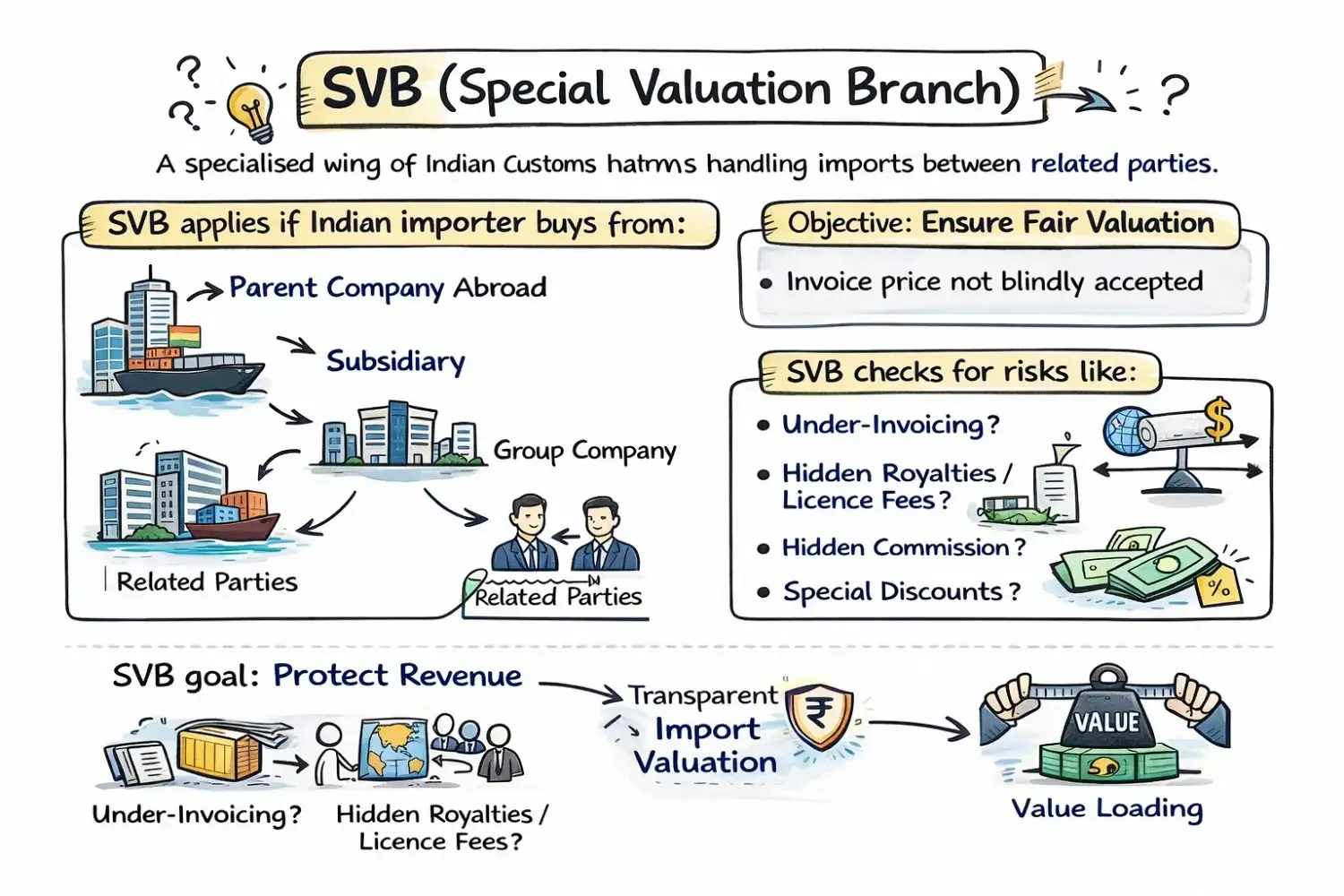
In today’s globalized business environment, India has become one of the most important destinations for multinational companies. From electronics and automobiles to pharmaceuticals and medical devices, thousands of foreign companies sell their products in India through their Indian subsidiaries, distributors, or group companies. While this creates huge business opportunities, it also creates a complex challenge for Indian Customs: Are these imports being declared at a fair and genuine value?
This is where SVB – Special Valuation Branch comes into the picture.
Most importers hear the term “SVB” with anxiety, but in reality, SVB is not a raid or enforcement wing. It is a specialised valuation department of Indian Customs created to ensure that related-party imports are priced fairly and government revenue is protected.
Let us understand what SVB is, why it exists, and how proper SVB consultancy can simplify cargo movement and avoid disruptions.
What is SVB (Special Valuation Branch)?
SVB is a specialised wing of Indian Customs that deals with imports between related parties.
Whenever an Indian importer purchases goods from:
- its parent company abroad,
- its subsidiary,
- a group company,
- or a company where directors, shareholders or management are common,
such transactions are called related-party transactions.
In such cases, Customs cannot blindly accept the invoice value, because there is a possibility that:
- prices may be reduced to save customs duty,
- royalty, licence fee or commission may be shifted separately,
- or special discounts may be given that distort market value.
SVB’s job is to examine whether the declared import price reflects a fair market value or whether it needs adjustment (loading).
Why was SVB created?
The Government of India created SVB to ensure:
- Fair competition in the Indian market
- No undervaluation or profit shifting
- No loss of customs revenue
- Compliance with WTO and Customs Valuation Rules
SVB does not exist to punish companies. It exists to ensure pricing transparency and fairness when business is done between related entities.
When does an importer fall under SVB?
An importer must register with SVB when:
- The foreign supplier and Indian buyer are related
- The importer pays royalty, licence fees, or technical fees
- There are special discounts or pricing arrangements
- There is any financial or management control between the two entities
This registration is normally voluntary. However, if an importer does not declare the relationship, Customs may later detect it and start investigation, which can lead to delays, audits and litigation.
What does SVB actually check?
SVB does not conduct raids. It performs valuation due diligence. This includes:
1. Relationship review
Examining shareholding, directors, control, agreements, and business links.
2. Pricing comparison (Arm’s Length Test)
Comparing
- Price charged to Indian subsidiary
versus
- Price charged to unrelated buyers in other countries
3. Royalty & Fee analysis
Checking if royalty, licence fee, marketing fees, franchise fees, or commissions are part of the real cost of goods and should be added to customs value.
4. Valuation methods used
- Transaction value
- Identical goods method
- Similar goods method
- Deductive value method (reverse calculation from sale price)
- Computed value (cost of production + profit)
- Residual methods based on market data
The objective is simple:
Is the declared import value fair?
What happens if Customs finds undervaluation?
If SVB finds that:
- the importer is getting excessive discounts,
- or royalty should be added,
- or price is not at arm’s length,
they may apply “loading” on the declared value.
This means customs duty will be calculated on a higher assessed value.
This is not a penalty.
It is only a correction of valuation so that government revenue is protected.
How SVB Consultancy simplifies cargo shipping
This is where professional SVB consultancy becomes extremely powerful.
Without proper guidance:
- Cargo can get stuck
- Provisional assessments continue for years
- Heavy bank guarantees are demanded
- Cash flow suffers
- Importers face audits and litigation
A professional SVB consultant ensures:
1. Correct SVB registration
Your relationship, agreements and disclosures are filed properly from day one, avoiding later investigations.
2. Proper documentation
Transfer pricing documents, royalty agreements, technical collaboration agreements and price lists are structured in a way Customs understands.
3. Faster SVB closure
A well-prepared SVB case can be finalised in months instead of years.
4. Lower duty exposure
Incorrect valuation leads to over-payment of duty. Correct representation ensures only legitimate additions are made.
5. Smooth cargo clearance
When SVB is handled properly, shipments clear without delays or repeated queries.
Why SVB is not an enemy
Many importers fear SVB, but in reality:
- SVB officers are professional and cooperative
- Their job is to apply valuation rules, not harass businesses
- They aim for transparency, not penalties
SVB exists because related-party trade is normal in global business, but government revenue must also be protected.
Final Thoughts
SVB is not a threat.
SVB is a valuation framework.
With correct consultancy, SVB becomes a compliance tool that:
- protects importers from future disputes,
- ensures smooth logistics,
- and keeps business legally strong.
In a world where global companies operate through complex structures, SVB ensures that India remains a fair, transparent, and compliant trade destination.
Author: Gaurav Upal
(Logistics & Customs Consultant)
Also Read