When cargo doesn’t fit the box, logistics needs to think
outside the box.In global shipping, not all cargo is neat, compact, or container-friendly. Heavy machinery, oversized equipment, industrial vehicles, and large structural components often exceed the height, width, or shape limits of standard containers. This is exactly where
Flat Rack Containers become a game-changer.Let’s break down what flat rack containers are, why they matter, and how they help businesses move complex cargo efficiently and cost-effectively.
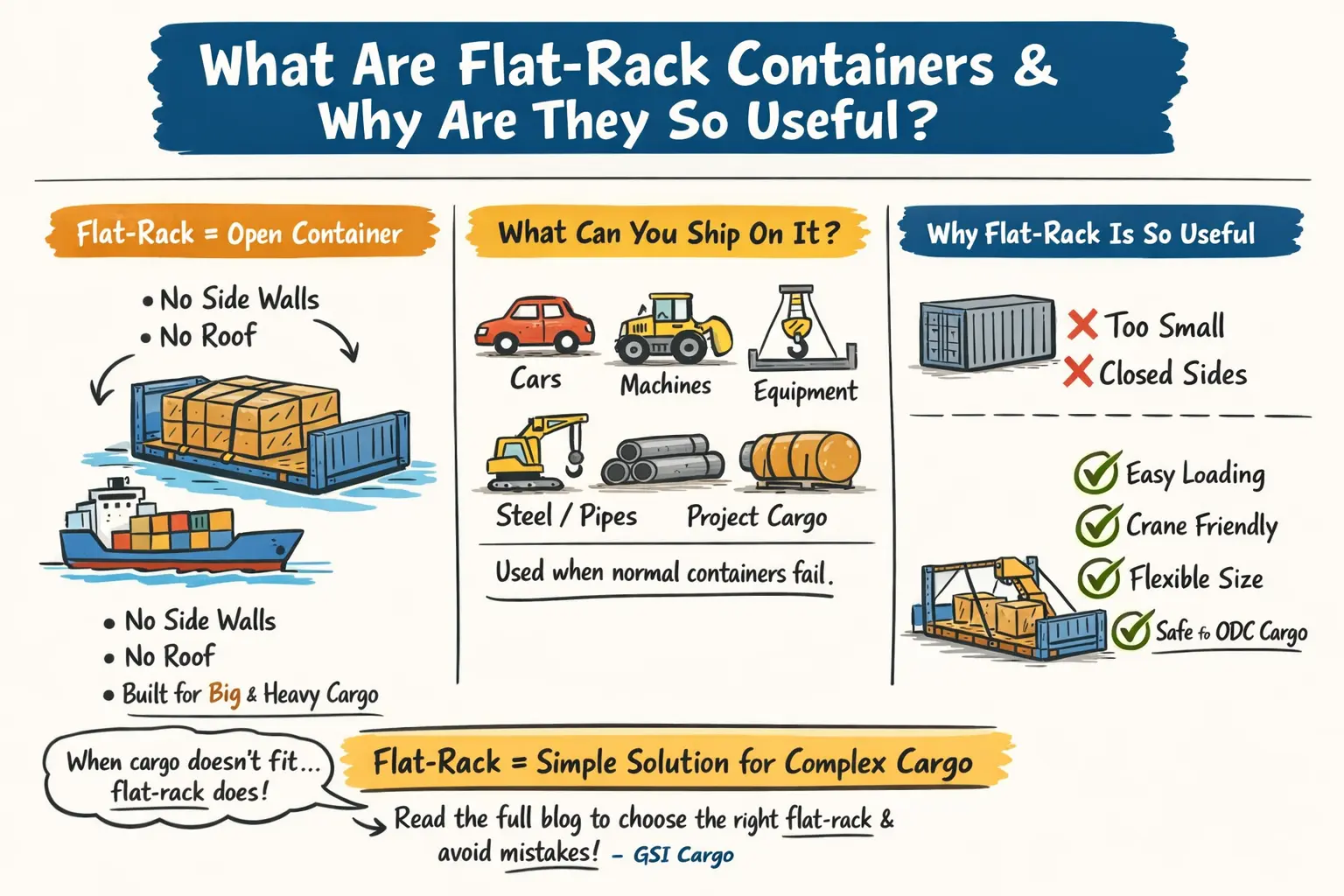
What Is a Flat Rack Container?
A
Flat Rack Container is a special type of shipping container designed for
oversized, heavy, or awkwardly shaped cargo that cannot be loaded into standard dry containers.Unlike normal containers:
- Flat racks do not have a roof
- Most have no side walls
- They consist mainly of a strong floor and end walls (some versions fold)
This open design allows cargo to be loaded
from the top or the sides, making it ideal for items that are too tall, too wide, or too heavy for enclosed containers.
What Type of Cargo Uses Flat Rack Containers?
Flat racks are primarily used for
project cargo and industrial shipments, such as:
- Heavy construction machinery
- Industrial and manufacturing equipment
- Power plant components
- Large pipes, steel coils, and fabricated structures
- Vehicles, buses, and special-purpose trucks
- Partially assembled machines or plant modules
In simple terms,
if it doesn’t fit inside a box, it probably fits on a flat rack.Why Flat Rack Containers Are So Important
1. Designed for Oversized CargoStandard containers have fixed dimensions. Flat racks remove these constraints by allowing cargo to
overhang safely (within approved limits). This flexibility makes them indispensable for infrastructure and industrial projects.
2. Strong Load-Bearing CapacityFlat racks are built with
reinforced flooring, capable of handling extremely heavy loads—often between
15 to 18 tons, and sometimes more depending on vessel and distribution.
3. Safer Loading and SecuringSince cargo is loaded openly, it can be:
- Lifted directly by crane
- Positioned accurately
- Secured using lashing points, chains, and stoppers
This reduces the risk of damage during stuffing and transit.
Flat Rack vs Open Top Containers: What’s the Difference?
This is a common question in project logistics.
Open Top Containers:- Have four side walls
- No roof (covered with tarpaulin)
- Cargo is loaded from the top
- Can still be stacked like normal containers
Flat Rack Containers:- Have no side walls and no roof
- Cargo is completely exposed (secured properly)
- Cannot be stacked with cargo on top
- Usually placed at specific vessel positions
Rule of thumb:- If cargo is tall but compact → Open Top
- If cargo is wide, long, or irregular → Flat Rack
Why Are Flat Rack Freight Rates Higher?
Flat rack shipments typically cost
3–4 times more than standard containers, and here’s why:
- No Stacking Advantage
Normal containers can be stacked multiple levels high. Flat racks cannot have cargo placed on top of them.
- Limited Vessel Slots
Every vessel has a fixed and limited number of flat rack positions (for example, 10–15 slots per ship).
- Special Vessel Planning
Flat racks are loaded:
- On deck
- On side stacks
- Or at under-deck positions specifically designed for them
This requires detailed vessel stability and lashing calculations.
- Extra Handling & Lashing Costs
Flat rack cargo needs special supervision, stronger lashings, and stricter compliance checks.
Available Sizes of Flat Rack Containers
- 40’ Flat Rack – Most commonly used
- 20’ Flat Rack – Less commonly available
In practice, most carriers and shippers prefer
40’ flat racks, as they provide better flexibility and cost efficiency for oversized cargo.High-cube flat racks exist, but structurally, the difference is minimal—the decision depends more on cargo dimensions than container height.
Weight Limits: Is There a Restriction?
Technically, flat racks follow similar
gross weight limits as standard containers. However, in real-world operations:
- Weight depends on cargo distribution
- Vessel stability requirements
- Crane and port handling limits
Most flat rack shipments fall safely within
15–18 tons, making weight less of a concern than
dimensions and balance.
Flat Rack vs Breakbulk Cargo
Another important comparison.
Breakbulk Cargo:- Loaded piece-by-piece
- No container used
- Very high handling and port costs
- Requires specialized vessels
Flat Rack Cargo:- Still containerized
- Easier documentation and tracking
- Lower risk than pure breakbulk
- Often cheaper than breakbulk
Many project cargo shipments today are
converted from breakbulk to flat rack to reduce cost and risk.
Smart Project Cargo Planning: The Key to Cost SavingsFor large projects (plants, factories, infrastructure), cargo is rarely uniform. A smart logistics strategy often involves
splitting cargo:
- General cargo → Standard containers
- Tall cargo → Open top containers
- Wide/heavy cargo → Flat racks
- Extremely oversized cargo → Breakbulk
When planned correctly, this
multi-modal container strategy can reduce logistics costs significantly while maintaining safety and timelines.
Final Thoughts
Flat rack containers are not just an alternative—they are a
strategic logistics solution for oversized and heavy cargo. While they come at a premium, their flexibility, safety, and global availability make them far more efficient than traditional breakbulk in many cases.With proper cargo assessment, dimension analysis, and professional guidance, flat racks can turn complex shipments into smooth, reliable operations.
In project logistics, the right container choice isn’t an expense—it’s an investment.

 My GIA Now