

 My GIA Now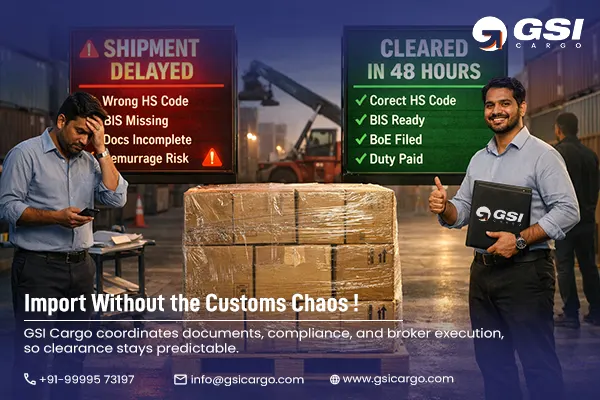
Import customs clearance in India may look complicated at first, but when planned properly, it becomes a smooth and manageable process. In this blog, we are sharing a simple, step-by-step guide for import customs clearance in India, especially useful for first-time importers and growing businesses.
To make things easy, we divide the entire import customs clearance process into two major parts:
- Pre-Customs Clearance Planning
- Procedures at the Time of Customs Clearance
Let’s understand each part in detail.
Part 1: Pre-Customs Clearance Planning
(Must be done 2–3 months before importing goods)
This is the most important stage of the import process. Proper planning at this stage can save importers from delays, penalties, and unnecessary costs later.
Before we begin, we assume that the importer already has:
- Importer Exporter Code (IEC)
- AD Code registration
- Proper company registration (imports should be done as a registered business, not as an individual)
Once these basics are in place, the importer should focus on the following steps.
1. Appoint a Reliable Customs Clearance Broker
The first and most important step is to identify and discuss the shipment with a professional customs clearance broker. A good broker helps in understanding documentation, compliance requirements, duty structure, and the overall clearance process.
It is always recommended to involve the broker well in advance, not after the cargo is shipped.
2. Correct HS Code Identification
HS Code (Harmonised System Code) is the foundation of customs clearance. It decides:
- Classification of goods
- Applicable customs duty
- Compliance and regulatory requirements
Importers must carefully research the correct HS Code for their product.
A common mistake is assuming that parts of machinery will fall under the same HS Code as the complete machine, which is not always correct.
HS Code research should be done using:
- Customs tariff notifications
- Government portals
- Guidance from the customs broker
Understanding all notifications linked to the HS Code is equally important.
3. Understand the Customs Duty Structure
Customs duty in India is generally divided into two parts:
- Customs Duty – added to the cost of goods
- GST – which can be claimed as input tax credit as per GST rules
Knowing the duty structure helps importers calculate the correct landed cost and plan pricing in advance.
4. Compliance & Mandatory Registrations
Most imported products require specific registrations and compliances, such as:
- BIS (Bureau of Indian Standards)
- EPR for electronics and plastic products
- Proper labelling (country of origin, importer details, etc.)
- ETA/WPC approvals for wireless and electronic goods
Importing without required compliances can result in cargo being stuck at customs.
Hence, compliance research should be completed at least 2–3 months before shipment.
5. Freight Cost Estimation & Transit Time Planning
Freight charges are not fixed throughout the year. Importers should understand:
- Air freight vs sea freight trends
- Peak season vs lean season rates
- Expected transit times
During festive or peak seasons, freight costs are usually higher, and vessel or space availability may be limited. Advance planning helps avoid last-minute surprises.
6. Free Trade Agreement (FTA) Awareness
Importers should check whether their goods are coming from a country where a Free Trade Agreement (FTA) is applicable.
If eligible, FTA benefits can significantly reduce customs duty. Importers must ensure:
- Correct country of origin
- Valid certificate of origin
- Compliance with FTA rules
7. Market & Supplier Research
It is advisable to conduct market research on:
- Competitor import prices
- Supplier credibility
- Industry standards
If the declared invoice value is significantly lower than market value, customs may ask for justification or conduct valuation checks.
Part 2: Customs Clearance at the Time of Arrival
Once the goods arrive in India, the following steps are involved:
1. Appointment of Customs Broker & KYC
The importer must submit KYC documents to the customs broker and register the AD Code at the port or airport, especially for first-time imports.
2. Submission of Pre-Alert Documents
Pre-alert documents should be shared in advance:
- Sea shipments: 10–15 days before arrival
- Air shipments: 2–3 days before arrival
Documents may include:
- Commercial invoice
- Packing list
- Product catalogue
- Technical write-up
- Valuation documents
Early submission helps avoid last-minute issues.
3. Arrange Funds in Advance
Importers must be ready to pay:
- Customs duty
- GST
- Shipping line charges
- Handling and port charges
Delays in payment can directly delay cargo release.
4. Close Coordination During Clearance
On the day of clearance, multiple activities take place:
- Bill of Entry filing
- Customs queries
- Examination and approvals
Close coordination between importer and customs broker is essential for smooth clearance.
5. Duty Payment & Cargo Delivery
After customs clearance:
- Pay duties and charges immediately
- Generate E-Way Bill
- Arrange transportation to warehouse or factory
6. Post-Clearance Best Practices
After clearance, importers should:
- Share written feedback with the customs broker
- Settle logistics invoices on time
- Maintain records for audits and future reference
Conclusion
Import customs clearance in India is not difficult when planned properly.
Early preparation, correct documentation, compliance awareness, and coordination with a professional customs broker can make the entire process smooth and predictable.
If you have questions or need guidance on import customs clearance, feel free to reach out. We are happy to assist and usually respond within 24 hours.
Planning an import? Facing customs queries or delays?
Connect with GSI Cargo today for expert guidance, transparent processes, and reliable support. Reach out now—our team responds within 24 hours and keeps your cargo moving without headaches.


Very rapidly this web site will be famous among all blogging people, due
to it’s good content
Hello to all, as I am genuinely eager of reading this blog’s post to be updated daily.
It contains nice information.
Hey there I am so glad I found your site, I really found you by
accident, while I was researching on Askjeeve for something else,
Anyhow I am here now and would just like to say thank you
for a remarkable post and a all round interesting blog (I also love the theme/design), I don’t have time to
look over it all at the minute but I have book-marked it and
also included your RSS feeds, so when I have time I
will be back to read a great deal more, Please do keep up the excellent work.
Hi there! I know this is kinda off topic
but I was wondering which blog platform are you using for this site?
I’m getting tired of WordPress because I’ve had problems with hackers and I’m looking at options for another platform.
I would be awesome if you could point me in the direction of a good platform.
Logging in feels like stepping into a cozy casino lobby every single time. The game selection is massive and the withdrawals are surprisingly fast. Highly recommend this spot for anyone chasing big wins. winspiritcasinologin
Finally found a site that actually listens to what players need. Live dealer games are crystal clear and the chat feature makes it feel like being at a real table. I highly recommend giving onlinegame777 a spin today.