

 My GIA Now
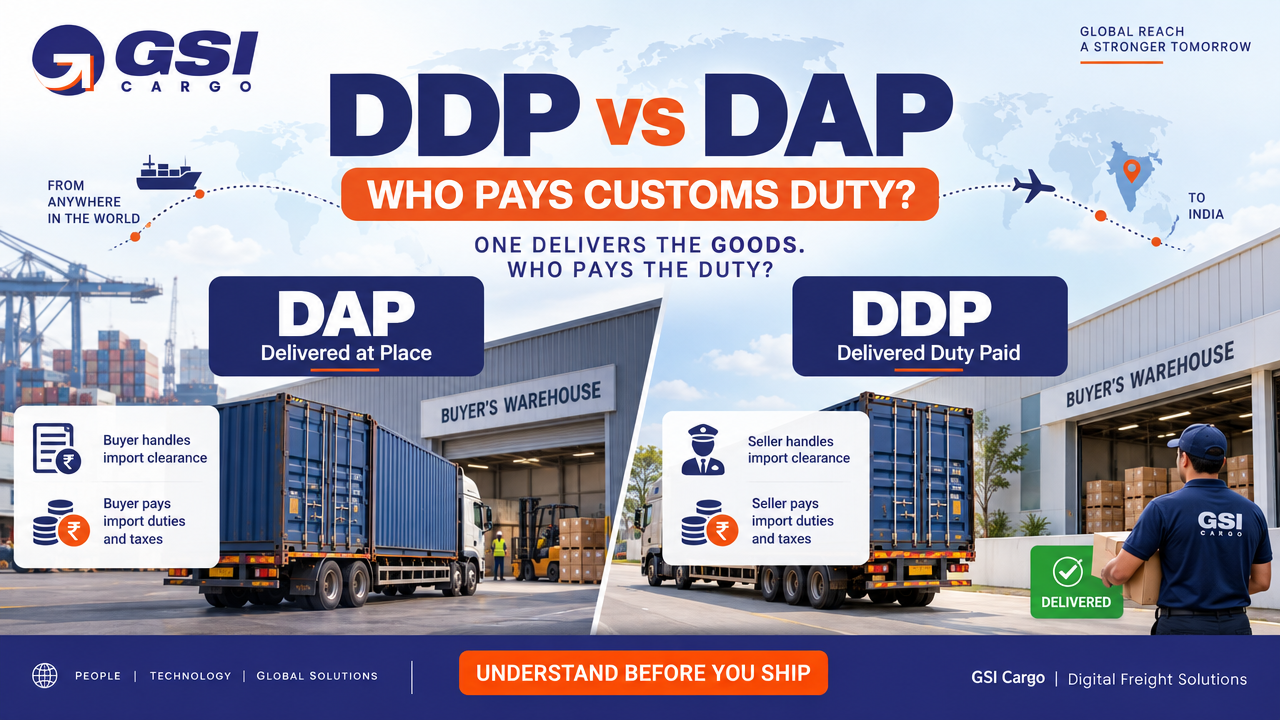
In international trade, door-to-door delivery has become increasingly popular as businesses look to simplify logistics, control costs, and reduce operational complexity. However, one important question often arises: Should you choose DDP (Delivered Duty Paid) or DAP (Delivered at Place) for your international shipments?
At GSI Cargo Private Limited, with over 26 years of experience in international freight forwarding, we understand how choosing the right Incoterm can significantly impact your import and export operations.
What Are Incoterms?
Incoterms, published by the International Chamber of Commerce (ICC), are internationally recognised trade rules that define the responsibilities of buyers and sellers regarding transportation, delivery, costs, and risks.
Common Incoterms include EXW, FOB, CFR, CIF, DAP, and DDP. Among these, DAP and DDP are particularly relevant for businesses seeking door-to-door delivery solutions.
What Is DAP (Delivered at Place)?
Under DAP, the seller arranges transportation and bears the cost and risk of delivering the goods to the agreed destination, such as the buyer's warehouse.
However, the buyer is responsible for import customs clearance, customs duties, and applicable import taxes.
For example, if a supplier in China ships machinery to an Indian buyer under DAP terms, the supplier arranges transportation to the agreed delivery location. The Indian buyer handles import customs clearance and pays the applicable duties and taxes before the goods can be delivered.
DAP is ideal for businesses that prefer to manage their own customs clearance and import compliance.
It is particularly useful for large companies with established customs teams, designated customs brokers, and internal procurement processes.
What Is DDP (Delivered Duty Paid)?
Under DDP, the seller assumes responsibility for delivering the goods to the agreed destination, including export formalities, transportation, import customs clearance, and applicable import duties and taxes.
The buyer generally receives the goods at the agreed destination without having to manage the import process directly.
For example, a foreign supplier sending product samples to an Indian company for evaluation may be asked to arrange DDP delivery. This allows the buyer to assess the product without managing the shipment's import formalities.
However, DDP requires careful planning. The seller must ensure that the import requirements can legally be fulfilled in the destination country. In India, the foreign seller may need an eligible importer of record (IOR) arrangement or an authorised local importing entity, depending on the transaction and applicable regulations.
Key Differences Between DAP and DDP
| Responsibility | DAP | DDP |
|---|---|---|
International transportation | Seller | Seller |
Delivery to agreed destination | Seller | Seller |
Import customs clearance | Buyer | Seller |
Customs duties and import taxes | Buyer | Seller |
Import compliance | Primarily Buyer | Seller, subject to local law |
Which Incoterm Should You Choose?
Choose DAP if your company has an established customs clearance team, prefers direct control over import documentation, and wants to manage duties and taxes internally.
Choose DDP if you prefer a more comprehensive delivery solution, particularly for samples, e-commerce shipments, or transactions where the buyer wants minimal involvement in import formalities.
For Amazon FBA shipments and other e-commerce deliveries, DDP may be attractive, but sellers must verify the platform's requirements and arrange suitable import clearance and IOR services where necessary. Simply quoting DDP does not automatically resolve these compliance requirements.
It is also worth noting that DAP replaced the older DDU (Delivered Duty Unpaid) rule under Incoterms 2010. Unlike DDU, DAP clearly defines delivery at the agreed destination while leaving import clearance and duties with the buyer.
Simplify International Shipping with GSI Cargo
Choosing between DAP and DDP is not merely about freight rates. It is about understanding your customs obligations, tax exposure, risk allocation, and the total landed cost of your shipment.
GSI Cargo Private Limited provides international freight forwarding, customs clearance, and DAP and DDP shipping solutions to support businesses trading across global markets.
Contact GSI Cargo for professional guidance, transparent costing, and a shipping solution tailored to your business requirements.
GSI Cargo Private Limited — Your Partner in Digital Freight Forwarding and Global Trade.
Also Read : 10 Tips to Reduce Sea Freight Costs for Imports to India

