

 My GIA Now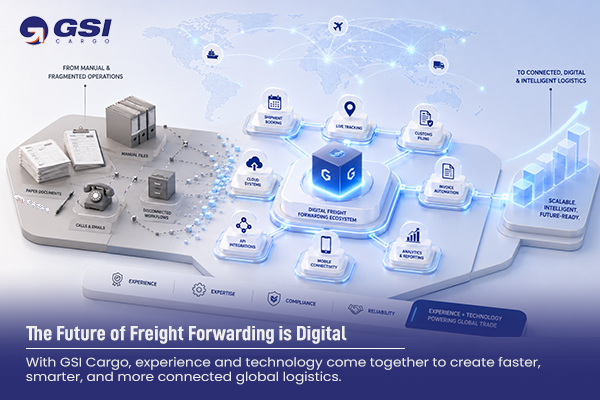
The Rise of Digital Freight Forwarding
The international freight forwarding industry is undergoing one of the biggest transformations in its history. According to GSI Cargo Pvt. Ltd., freight forwarding companies are no longer just “freight forwarding companies.” The future belongs to Digital Freight Forwarding Companies.
From Manual Operations to Digital Transformation
If we go back 20 to 30 years, the freight forwarding industry operated very differently. Most work was handled manually:
- Physical documentation
- Manual filing systems
- Handwritten records
- Paper-based airway bills and bills of lading
- Basic communication methods
At that time, the arrival of computers itself was considered revolutionary. Using Microsoft Excel, Word documents, and simple computer systems was enough for handling freight operations.
But the world has changed dramatically in the last two decades.
Explore our Air Freight Solutions
The New Era of Digital Freight Forwarding
Today, the logistics industry is driven by:
- Artificial Intelligence (AI)
- Machine Learning
- Cloud-based software
- Blockchain technology
- Data security systems
- Automation
- Mobile applications
- API integrations
- Real-time tracking systems
Digital freight forwarding means a company operates on a fully integrated technology-driven ecosystem where every process is digitally managed and connected.
Explore our Sea Freight Solutions
What Makes a Company a Digital Freight Forwarder?
A digital freight forwarding company is structured around automation and software systems. Every stage of the logistics process is digitally connected, including:
- Customer onboarding
- Quotation management
- Shipment bookings
- Digital documentation
- Customs filing
- Accounting systems
- Invoice generation
- MIS reporting
- Dashboard analytics
- Live cargo tracking
- Mobile application support
- Cloud data management
Today’s customers expect:
- Immediate responses
- Fast quotations
- Accurate pricing
- Live shipment visibility
- Digital communication
This speed is only possible through advanced software systems and automation.
The Changing Behavior of Customers
There was a time when customers waited for days to receive quotations and shipment updates. Today, the market has changed completely.
Modern customers are:
- Faster decision-makers
- More digitally connected
- Highly informed
- Expecting instant service
At the same time, airlines, shipping lines, and customs authorities have also shifted to digital systems and electronic data exchange through APIs and online portals.
Digitalization is no longer optional — it has become a necessity.
Customs compliance and clearance support
Challenges for Small Freight Forwarders
One of the biggest challenges in today’s logistics industry is the high cost of digital transformation.
Small and newly established freight forwarding companies often struggle with:
- Expensive software investments
- Technology infrastructure costs
- Skilled manpower requirements
- Automation systems
- Data security management
Over the last 20 years, the industry has witnessed that many small and unorganized companies are disappearing, while larger organized companies are growing rapidly through technology and structured systems.
This is a critical time for MSME freight forwarders to rethink their future strategies and adopt digital transformation before the market becomes even more competitive.
Experience + Technology = Future Success
While technology is essential, logistics still requires strong operational expertise and industry knowledge.
At GSI Cargo Pvt. Ltd., we strongly believe that the backbone of freight forwarding remains:
- Shipment handling expertise
- Operational knowledge
- Compliance understanding
- Experienced professionals
- Customer relationship management
That is why GSI combines:
- Experienced logistics professionals with 10–20 years of expertise
- Advanced digital freight forwarding systems
- Integrated software platforms
- Real-time operational visibility
Every shipment, customer detail, operational process, and communication is digitally available across departments for faster and more efficient service.
The Future of Freight Forwarding in India
The future of freight forwarding in India is highly promising because:
- Global trade is growing rapidly
- E-commerce is expanding
- Cross-border business is increasing
- Supply chains are becoming faster
- Global markets are becoming locally accessible
Today, “Global is Local.”
In this rapidly changing environment, organized companies using digital tools and corporate structures have better scalability, efficiency, and growth potential.
However, the industry is also becoming more competitive, and profit margins are reducing. To survive and grow, freight forwarders must:
- Adopt digital systems
- Build organized structures
- Improve operational efficiency
- Invest in technology
- Create long-term partnerships
GSI Cargo’s Vision for the Industry
At GSI Cargo Pvt. Ltd., we believe the future of logistics should be collaborative, not isolated.
We welcome:
- Industry partnerships
- MSME collaborations
- Freight forwarding alliances
- Shared knowledge systems
- Technology integration opportunities
GSI is ready to share:
- Industry knowledge
- Operational experience
- Digital systems
- Software capabilities
- Business support structures
We want the logistics industry to grow together and help smaller freight forwarders become part of the digital revolution.
Conclusion
The future of freight forwarding is digital, automated, and technology-driven.
The companies that adapt quickly will grow stronger. The companies that resist change may struggle in the coming years.
This is the time to:
- Adopt digital freight forwarding
- Build organized corporate structures
- Embrace automation
- Collaborate with industry leaders
- Become part of the global logistics revolution
The future is already here.
Let’s be part of the change.