

 My GIA Now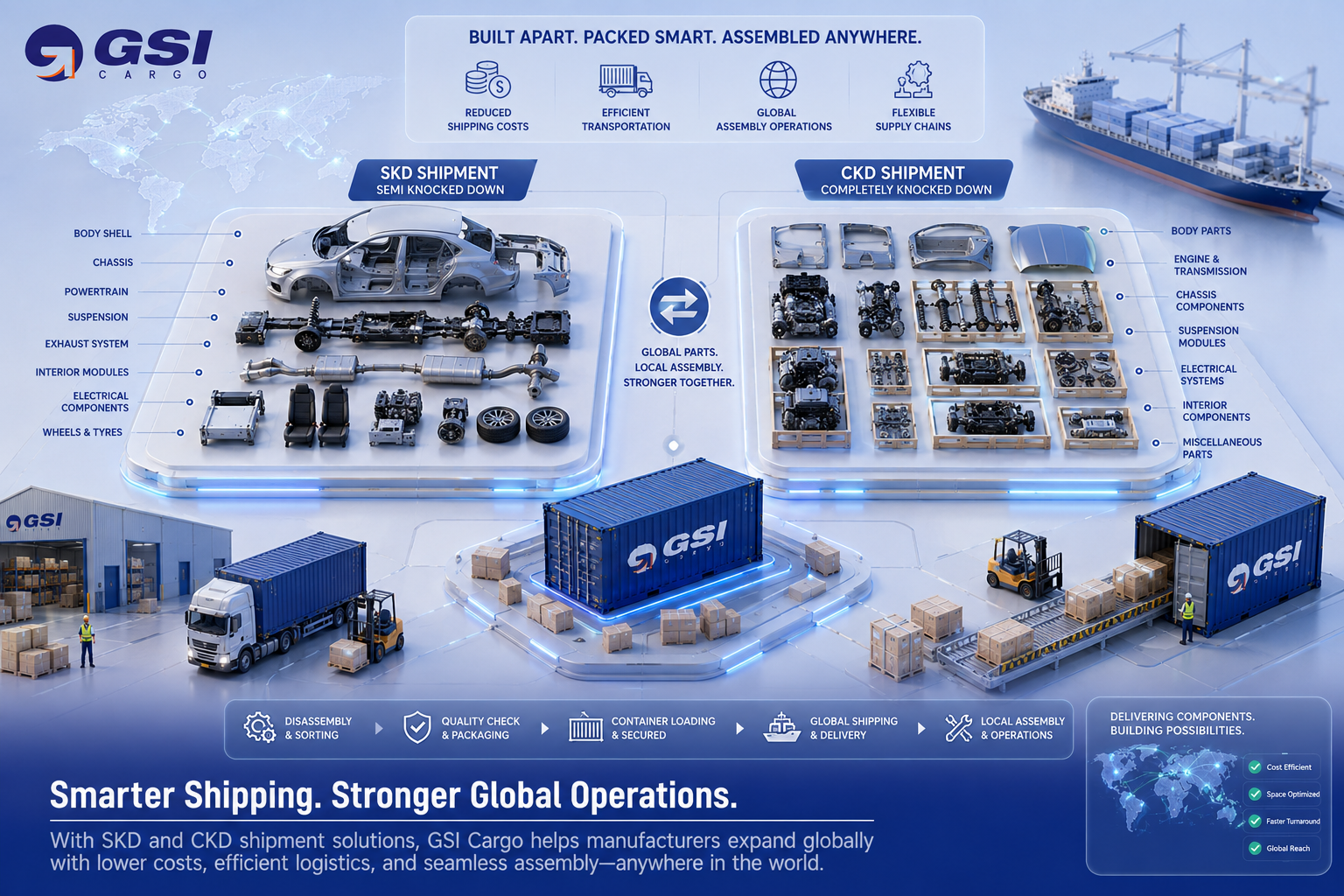
Imagine a vehicle manufacturer planning to enter a fast-growing overseas market. Demand is strong, but there's a problem. Shipping fully assembled vehicles attracts high import duties, consumes more container space, and increases overall logistics costs. As a result, profit margins shrink before the products even reach customers.
To overcome these challenges, many global manufacturers turn to SKD and CKD Shipments—two proven logistics models that reduce costs, support local assembly, and improve market competitiveness.
In today's global trade environment, understanding these shipment methods can create a significant advantage. Many businesses unknowingly pay higher duties by shipping fully assembled products. Meanwhile, companies that optimize their SKD and CKD logistics often gain a significant cost advantage in competitive markets.
What Are SKD and CKD Shipments?
SKD (Semi Knocked Down) and CKD (Completely Knocked Down) refer to products shipped in partially or fully disassembled form for assembly at the destination.
SKD (Semi Knocked Down)
In a Semi Knocked Down shipment, the product is partially assembled before shipping. Major components are pre-assembled, while final assembly takes place at the destination.
For example, a motorcycle manufacturer may ship the engine and frame assembled while sending wheels, seats, and accessories separately.
CKD (Completely Knocked Down)
In a Completely Knocked Down shipment, the product is fully disassembled into individual components and shipped separately. The entire product is assembled in the destination country.
Automobile manufacturers commonly use this model when establishing local assembly operations.
SKD vs. CKD: Understanding the Key Differences
Although both methods involve shipping components instead of finished products, they differ significantly.
| SKD Shipment | CKD Shipment |
|---|---|
| Partially assembled | Fully disassembled |
| Faster assembly at destination | More extensive assembly required |
| Lower labor requirements | Higher labor requirements |
| Moderate duty savings | Potentially greater duty savings |
| Simpler packaging | More complex packaging and inventory management |
The choice depends on factors such as labor availability, import regulations, assembly infrastructure, and cost objectives.
Why Businesses Choose SKD and CKD Cargo Models
As global supply chains evolve, efficient component-based shipping is becoming a key strategy for international expansion.
Manufacturers use SKD cargo transportation and CKD logistics to:
- Reduce import duties and taxes
- Optimize container utilization
- Lower transportation costs
- Support local manufacturing initiatives
- Meet government localization requirements
- Improve market access
- Increase operational flexibility
Many countries encourage local assembly through favorable duty structures, making SKD and CKD models attractive for international businesses.
Benefits of SKD Shipments
1. Reduced Freight Costs: Partially assembled products often occupy less shipping space than fully assembled units, improving container efficiency.
2. Faster Market Entry: Since some assembly work is already completed, products can reach customers more quickly.
3. Lower Assembly Complexity: Businesses need fewer resources and less technical expertise for final assembly.
4. Duty Optimization: In many markets, Semi Knocked Down shipment imports may qualify for lower duties compared to fully assembled products.
Advantages of CKD Logistics
1. Maximum Cost Efficiency: A completely Knocked Down shipment often provides the greatest opportunity for duty savings.
2. Better Container Utilization: Components can be packed efficiently, reducing transportation costs.
3. Local Manufacturing Benefits: CKD operations create employment opportunities and support local industrial development.
4. Enhanced Market Competitiveness: Businesses can offer more competitive pricing due to reduced import and logistics expenses.
However, a poorly planned CKD shipment can lead to costly assembly delays and customs issues, making proper logistics management essential.
5. Industries That Commonly Use SKD and CKD Shipping: Several industries rely heavily on SKD and CKD Shipments.
6. Automotive Industry: Cars, motorcycles, buses, and commercial vehicles are frequently shipped as SKD or CKD kits.
7. Industrial Machinery: Heavy machinery and manufacturing equipment are often disassembled for easier transportation.
8. Electronics: Large electronic products may be shipped in component form for local assembly.
9. Industrial Equipment: Generators, production systems, and specialized equipment frequently utilise CKD logistics strategies.
10. Documentation and Customs Requirements: Proper documentation is critical for successful import-export logistics operations.
Key documents often include:
- Commercial Invoice
- Packing List
- Bill of Lading or Air Waybill
- Certificate of Origin
- Product Specifications
- Assembly Instructions
- Import Licenses (where applicable)
Accurate classification is especially important for customs clearance for CKD shipments, as customs authorities closely examine component breakdowns and duty structures.
Common Challenges in SKD and CKD Shipping
While the benefits are significant, businesses may face several challenges:
1. Complex Inventory Management: Thousands of components must be tracked accurately.
2. Packaging Risks: Improper packing can result in missing or damaged parts.
3. Customs Delays: Incorrect documentation may trigger inspections and clearance delays.
4. Assembly Coordination: Missing components can halt production and delay deliveries.
5. Without proper planning, even a small component shortage can disrupt an entire assembly operation.
Best Practices for Smooth Cargo Movement
To ensure successful SKD and CKD operations:
- Create detailed packing lists
- Use component-level labeling
- Implement quality control procedures
- Plan assembly requirements in advance
- Work with experienced customs specialists
- Monitor shipment visibility throughout transit
- Partner with reliable freight forwarding service providers
These practices help reduce risks and improve operational efficiency.
How GSI Cargo Supports SKD and CKD Shipments
At GSI Cargo Private Limited, we understand the complexities involved in SKD and CKD cargo movement. Our experienced team provides end-to-end logistics support, including freight planning, customs coordination, cargo handling, warehousing, and transportation management.
Whether you're importing machinery, automotive components, industrial equipment, or electronic assemblies, we help streamline the process while minimizing delays and costs.
Conclusion
SKD and CKD Shipments have become powerful tools for manufacturers looking to expand globally while controlling costs. From duty optimization and freight savings to improved market access and local assembly opportunities, these shipment models offer significant strategic advantages.
Companies that fail to understand these logistics strategies may miss valuable opportunities to improve profitability and strengthen their competitive position.
Looking for reliable SKD and CKD logistics solutions? Contact GSI Cargo Private Limited today for expert freight forwarding, customs clearance, and end-to-end cargo management tailored to your business needs.