

 My GIA Now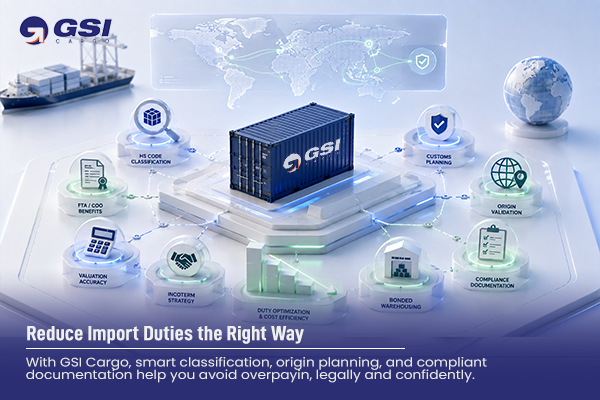
Introduction
India is a highly competitive and price-sensitive market. Importers constantly look for ways to reduce customs duties and overall import costs while remaining fully compliant with Indian Customs regulations. Proper planning, classification, documentation, and strategic import structuring can significantly reduce unnecessary duties, demurrage, and operational risks.
1. Correct HS Code Classification
HS Code (Harmonized System Code) classification is the foundation of customs duty calculation.
Importers must verify:
- Basic Customs Duty (BCD)
- IGST applicability
- Social Welfare Surcharge
- Anti-Dumping Duty
- Safeguard Duty
- Compensation Cess
- Product restrictions or licensing requirements
Importance:
Incorrect HS code classification may result in:
- Higher customs duty
- Penalties and notices
- Delayed customs clearance
- Cargo examination issues
Best Practice:
Always verify HS code with:
- Customs consultants
- CHA (Custom House Agent)
- Customs tariff notifications
Connect with GSI Cargo for smarter import and export solutions.
2. Product Compliance Evaluation
Before importing any product, compliance requirements must be checked carefully.
Examples:
- Electronics → BIS Certification/ LMPC/ EPR
- Wireless products → WPC Approval/ ETA Approvals/ Import License
- Steel products → Quality Control Orders/BIS Certification
- Textiles/Fabrics → Labelling compliance/Textile Testing (TTC)
- Chemicals → Hazardous substance regulations/Lab Tests reports
Why it matters:
Non-compliance can lead to:
- Cargo detention
- Heavy demurrage charges
- Customs penalties
- Re-export orders
Recommendation:
Evaluate compliance before shipment dispatch.
3. Use Free Trade Agreements (FTAs)
India has FTAs with several countries that provide reduced or zero customs duty benefits.
Key requirement:
Correct Country of Origin Certificate (COO)
Examples:
- ASEAN FTA
- India-UAE CEPA
- India-Australia ECTA
Benefits:
- Reduced customs duty
- Better landed cost
- Increased competitiveness
4. Evaluate Anti-Dumping Duties
Certain products attract anti-dumping or safeguard duties.
Strategy:
Check if:
- Alternative country sourcing is possible
- Importing under SKD/CKD format changes HS classification
- Product restructuring reduces duty exposure
Example:
Importing in dismantled form may reduce customs duty legally.
5. Country of Origin Planning
Country of origin plays a major role in:
- Duty rates
- FTA eligibility
- Compliance requirements
- Anti-dumping applicability
Recommendation:
Evaluate the sourcing country strategically before finalizing procurement.
6. Proper Customs Valuation
Always declare clean and accurate invoice values.
Important for:
- Related party imports
- Multinational companies
- Group company transactions
SVB (Special Valuation Branch)
If the buyer and supplier are related entities:
- Customs may apply SVB valuation
- Additional loading on assessable value may occur
Risk:
Incorrect valuation can lead to:
- Investigations
- Penalties
- Duty reassessment
7. Select Correct Import Terms (Incoterms)
Import terms directly impact customs valuation.
Important Note:
Custom duty in India is calculated on CIF value.
Example:
If low-value goods are imported by air under CIF basis:
- Customs duty may become extremely high on air shipments
- Similarly, customs duty increases in sea freight unnecessarily on inland freight
Better Strategy:
Use FOB imports when the freight cost is disproportionately high.
Looking for reliable freight forwarding and customs support? Contact GSI Cargo.
8. Use Customs Bonded Warehouse
Bonded warehousing allows importers to:
- Defer customs duty payment
- Store goods without immediate clearance
- Re-export goods
- Conduct relabeling/repacking activities
Useful for:
- Traders
- Re-exporters
- Seasonal inventory management
9. Bond-to-Bond Transfer
If your customer has:
- EPCG License
- Advance Authorization
- Duty exemption licenses
Then goods can be transferred directly under a bond.
Benefit:
The end customer can utilize the duty exemption benefits.
10. Import for Re-Export
If goods are imported only for:
- Relabeling
- Packaging changes
- Minor processing
- Third-country exports
Then bonded warehouse or FTWZ can be highly beneficial.
11. Use FTWZ (Free Trade Warehousing Zone)
FTWZ allows:
- Duty deferment
- Value addition
- Packaging/relabeling
- Consolidation/deconsolidation
Benefits:
- Better cash flow
- Global distribution advantages
- Reduced customs burden
12. Provisional Assessment
If customs disputes:
- HS classification
- Valuation
- Duty applicability
Importers can request a provisional assessment.
Process:
- Goods are released against bond/security
- The importer can file appeal later
- Excess duty paid can be refunded if the decision is favorable
13. Avoid Documentation Errors
Documentation mistakes are one of the biggest reasons for customs delays.
Verify:
- Invoice accuracy
- Packing list
- Product description
- HS Codes
- Country of Origin
- Compliance certificates
- Freight details
Recommendation:
Review all documents with CHA before shipment arrival.
Let GSI Cargo help you optimize your customs and freight strategy.
Conclusion
Reducing import customs duty legally is not about avoiding taxes — it is about proper planning, compliance, and strategic import management.
Businesses that focus on:
- Correct HS classification
- FTAs
- Compliance
- Bonded warehousing
- Proper valuation
- Documentation accuracy
can significantly reduce landed costs, improve cash flow, and avoid customs risks.
Proper customs strategy is now a competitive advantage in global trade.
Need help reducing import costs legally? Talk to GSI Cargo.
- Indian Customs Tariff Portal
- ICEGATE – Indian Customs Electronic Gateway
- DGFT – Directorate General of Foreign Trade
- CBIC – Central Board of Indirect Taxes & Customs
- India-UAE CEPA Agreement
- India-Australia ECTA Agreement
- WCO HS Code Information
- BIS Certification Portal
- WPC Approval Information
- SEZ & FTWZ Information – Ministry of Commerce