

 My GIA Now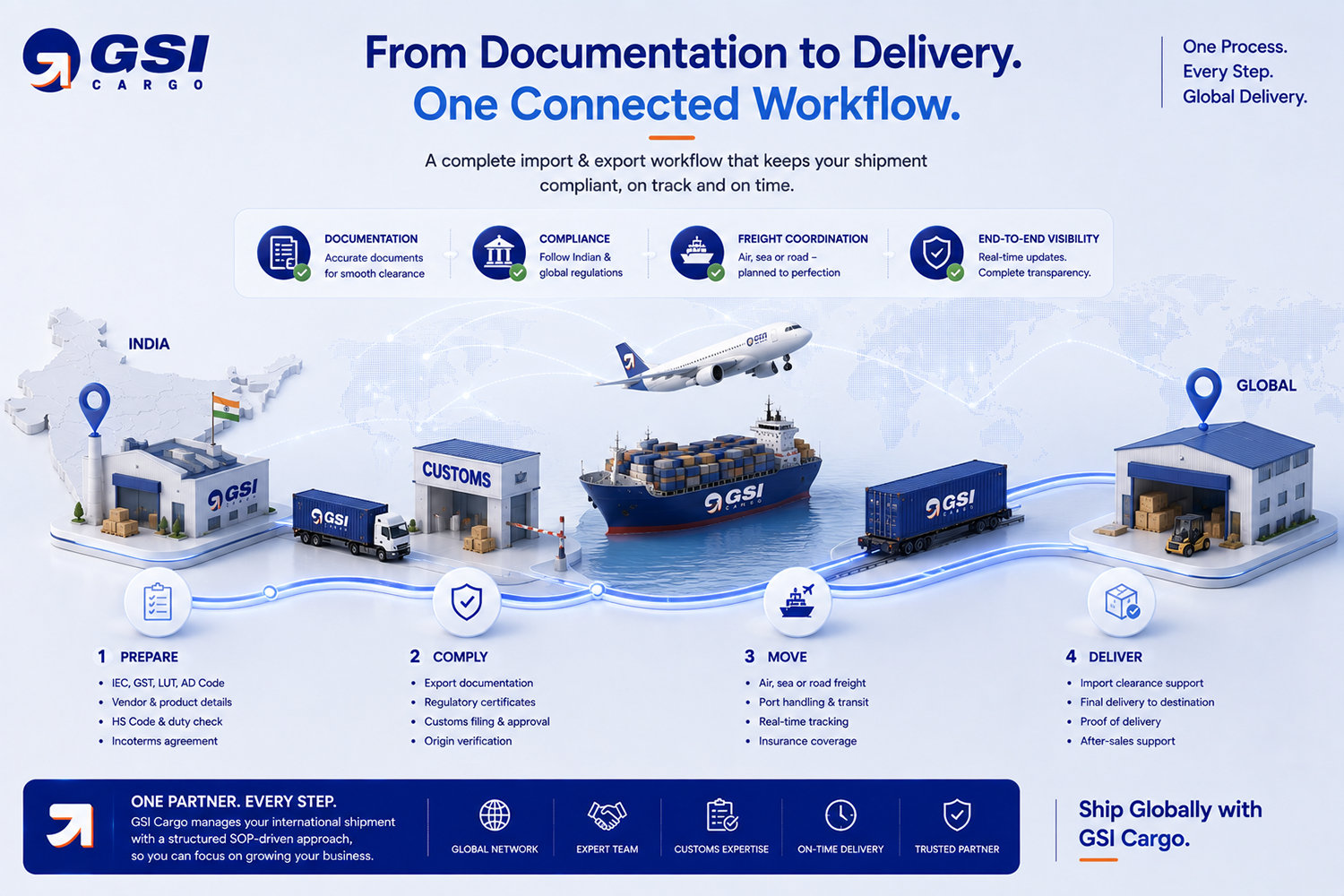
International trade opens the door to global markets, but moving goods across borders involves much more than simply booking a flight or vessel. A successful import or export shipment depends on a well-defined workflow, accurate documentation, regulatory compliance, customs procedures, and coordination between multiple stakeholders.
At GSI Cargo, we believe international shipping should work like a well-designed Standard Operating Procedure (SOP): every step should have a defined process, responsible person, documentation requirement, method of execution, and timeline. This approach creates consistency, accountability, and fewer opportunities for costly errors.
International vs. Domestic Shipping
Domestic shipping takes place within Indian territory, while international shipping involves the movement of goods across India's borders. International shipments require additional compliance because goods must pass through customs and meet both Indian and destination-country regulations.
International cargo from India can primarily move through three modes:
- Air freight – ideal for urgent, high-value or time-sensitive shipments.
- Sea freight – suitable for larger volumes and cost-efficient transportation.
- Road freight – commonly used for trade with neighbouring countries such as Nepal, Bangladesh and Pakistan, subject to applicable border and customs procedures.
For inland locations such as Delhi, Ludhiana or Jaipur, cargo can be moved to an Inland Container Depot (ICD) or other customs-enabled facility and subsequently transported by rail or road to the port of loading.
The Importance of an Import Export Code (IEC)
For commercial import and export transactions, an Import Export Code (IEC) is a fundamental requirement. It is issued through the Directorate General of Foreign Trade (DGFT).
The IEC establishes the identity of the importer or exporter for commercial international trade. Businesses may operate under different structures—such as proprietorships, partnerships or private limited companies—but the appropriate registration and documentation must be in place before undertaking commercial international shipments.
GST and Export Documentation
GST is primarily a domestic tax, but GST registration remains important for exporters because businesses generally purchase goods or services within India with applicable GST before exporting.
Exports can be made under applicable GST procedures, including the use of a Letter of Undertaking (LUT) where eligible. Proper documentation helps maintain the connection between domestic procurement, GST records and the export transaction.
Exporters should also understand their Authorised Dealer (AD) Code requirements. Foreign export proceeds are routed through the banking system, and the authorised dealer bank plays an important role in linking the foreign-currency payment with the corresponding export transaction.
Essential Export Documentation
A successful export shipment requires more than an invoice and a transport booking. Depending on the commodity and destination, documentation may include:
- Import Export Code (IEC)
- GST registration
- LUT, where applicable
- AD Code registration
- Commercial/Proforma Invoice
- Packing List
- Shipping instructions
- Country of Origin documentation
- Applicable preferential-origin documentation
- Insurance documentation
- Product-specific certificates and approvals
The exact requirements depend on the commodity, destination and applicable regulations.
For example, food products, wooden or handicraft products, cosmetics, leather products, chemicals, plant-related products and other specialised commodities may have additional regulatory requirements. Correct HS classification is therefore a critical part of the process because it helps determine customs duty, restrictions, documentation and regulatory requirements.
Incoterms and Freight Planning
Before shipment, the buyer and seller should clearly agree on the applicable Incoterms. These terms define responsibilities relating to transportation, costs, risk and delivery.
Once the commercial terms and shipping requirements are clear, the freight forwarder can prepare a comprehensive quotation covering the relevant transportation and logistics components.
Accurate shipping instructions are essential. They allow the freight forwarder, customs team, shipping line or airline and other stakeholders to work from the same information.
First-Time Importers: What Should You Check?
The import process requires the same level of preparation. Importers generally need to establish their IEC, GST and AD Code requirements and understand the regulatory implications of the commodity before the shipment arrives.
One of the most important steps is checking the HS Code and applicable customs requirements before placing an import order. This helps determine the expected customs duty, applicable restrictions, licences, certificates and other compliance requirements.
Certain categories—including electronics, medical equipment and other regulated products—may require additional approvals or compliance within India. Identifying these requirements before shipment can prevent customs delays, unexpected costs and storage or demurrage exposure.
Why a Structured Shipping Workflow Matters
International logistics involves exporters, importers, freight forwarders, customs brokers, airlines, shipping lines, ports, banks and government authorities. Without a structured process, responsibilities can become unclear and errors can occur.
A documented workflow creates accountability at every stage—from quotation and vendor selection to documentation, customs clearance, freight movement and final delivery.
At GSI Cargo, our approach is to bring this entire workflow together under one coordinated logistics solution. From freight forwarding and customs clearance to documentation guidance, HS classification support and shipment coordination, our objective is to help businesses move international cargo with greater clarity, control and consistency.
Ship Globally with GSI Cargo
Whether you are exporting from India for the first time, importing commercial goods, moving air or sea cargo, or managing a complex international shipment, professional planning can make the difference between a smooth shipment and an expensive delay.
GSI Cargo can help you understand the process, prepare the required documentation, coordinate freight and customs procedures, and manage your shipment from origin to destination.
Ready to move your next international shipment? Contact GSI Cargo and let our team help you build the right end-to-end shipping workflow.
Also Read : Courier vs Cargo: What’s the Difference?