

 My GIA Now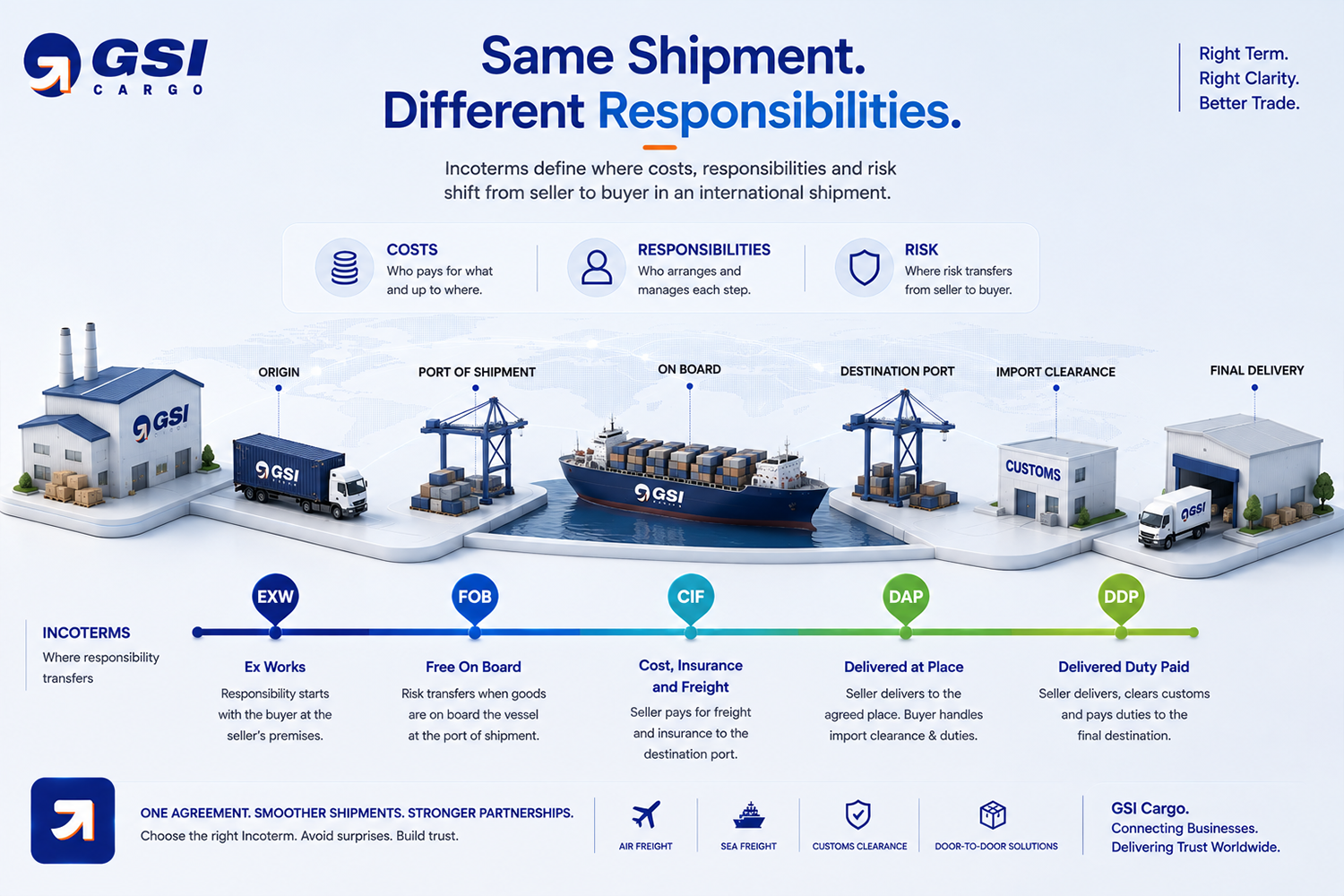
In international trade, one of the most important concepts for every exporter, importer and logistics professional to understand is Incoterms.
Whether you are a first-time exporter, an importer, a logistics professional or a business negotiating with an overseas buyer, knowing the applicable Incoterm is essential. It tells both the buyer and seller who is responsible for which costs, transportation activities and stages of the shipment.
When an exporter quotes a price to an international buyer, simply giving the product price is not enough. The buyer also needs to know: Is this an Ex-Works price? FOB? CIF? DAP? DDP?
The answer can significantly change the final landed cost.
What Does an Incoterm Tell You?
Consider an Indian manufacturer exporting laboratory equipment from Punjab to a buyer anywhere in the world.
The manufacturer may have different prices for different products and quantities. But when the buyer asks for a quotation, the exporter must clearly state the basis of that price.
For example, a product could be quoted on an EXW, FOB, CIF, DAP or DDP basis, depending on the commercial agreement.
The Incoterm essentially establishes the agreed division of responsibilities between the buyer and seller.
EXW – Ex Works
Under an EXW arrangement, the seller’s responsibility is broadly limited to making the goods available at the agreed location, such as the factory.
The seller prepares the goods and relevant commercial documentation and ensures appropriate export packaging. The buyer then takes responsibility for arranging the subsequent transportation and logistics.
For example, if a manufacturer in Punjab sells laboratory equipment on an EXW basis, the buyer or the buyer’s nominated logistics provider would arrange the movement from the factory onward.
This can be a straightforward option, but the parties must clearly understand the practical responsibilities involved in export formalities and transportation.
FOB – Free On Board
Under FOB, the seller takes responsibility for the agreed costs up to the point where the goods are loaded on board the vessel at the port of shipment.
This can include elements such as:
- Movement from the factory to the port
- Origin transportation
- Export customs clearance
- Applicable origin documentation
- Port-related charges
- Loading the cargo on board
Once the goods are on board, the buyer takes responsibility for the subsequent ocean freight and destination-side costs according to the agreed arrangement.
For example, an exporter may quote laboratory equipment at FOB Mumbai. The buyer then arranges the international ocean freight from the port onward.
CIF – Cost, Insurance and Freight
Under CIF, the seller goes further by including the cost of transportation and insurance to the agreed destination port.
Suppose an overseas buyer asks an Indian exporter for a CIF quotation to the UK. The exporter can calculate the product cost, applicable origin costs, international freight and required insurance and provide the buyer with a CIF price.
This gives the buyer a clearer view of the cost up to the agreed destination port.
DAP – Delivered at Place
Under DAP, the seller takes responsibility for delivering the shipment to the agreed destination.
However, the buyer remains responsible for applicable import customs clearance and import duties and taxes, subject to the precise contractual arrangement.
This can be useful when the buyer wants the seller to coordinate transportation almost up to the final delivery point while retaining responsibility for import customs formalities.
DDP – Delivered Duty Paid
DDP represents a much broader responsibility for the seller.
Under a DDP arrangement, the seller is generally responsible for delivering the goods to the agreed destination, including arranging import clearance and applicable duties and taxes, subject to the specific transaction and local requirements.
For example, many e-commerce and fulfilment shipments can involve a DDP-style landed-cost approach where the buyer expects a fully delivered price.
For DDP transactions, however, the importer-of-record and local customs requirements must be carefully evaluated. The shipment cannot simply be cleared without the appropriate consignee registration, customs authority and documentation.
Why Incoterms Matter to Freight Forwarders
Incoterms are not just a commercial term between buyer and seller. They directly affect the scope of work of the freight forwarder.
If an exporter nominates a freight forwarder for an FOB shipment, the forwarder’s responsibility may primarily involve origin pickup, export customs clearance and movement to the port, depending on the agreed scope.
If the buyer appoints the freight forwarder for a shipment arriving on a CIF basis, that forwarder may instead be responsible for destination-side activities such as customs clearance and delivery.
Therefore, understanding the Incoterm allows the logistics provider to immediately determine which party is responsible for which component of the shipment.
Incoterms Are Also a Negotiation Tool
Incoterms are an important part of international trade negotiations.
The same product can have very different quoted prices depending on whether the price is EXW, FOB, CIF, DAP or DDP.
That is why exporters should never compare two international quotations without first checking the Incoterm. A lower product price may not necessarily mean a lower landed cost if freight, insurance, customs clearance or duties are excluded.
For new exporters and importers, understanding Incoterms is therefore fundamental to making accurate commercial decisions.
Let GSI Cargo Help You Navigate International Trade
Choosing the right Incoterm requires an understanding of the shipment, destination, transportation mode, customs requirements and commercial responsibilities.
At GSI Cargo, we help exporters and importers understand the logistics implications of their international transactions—from freight forwarding and customs coordination to documentation and door-to-door shipment planning.
Whether you are managing your first export, first import, an FOB/CIF shipment or a complete DAP/DDP delivery, our team can help you understand the logistics workflow and coordinate the right solution.
Planning your next international shipment?
Contact GSI Cargo today for professional guidance on Incoterms, freight forwarding, customs clearance and end-to-end international logistics.
Also Read : Courier vs Cargo: What’s the Difference?