

 My GIA Now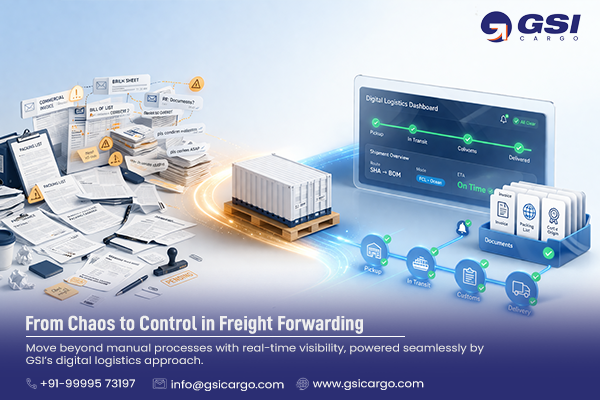
Digital Freight Forwarding
If you’re still managing international shipments with spreadsheets, forwarded emails, and “please confirm” WhatsApp messages… you’re not alone.
But in 2026, that approach is also the fastest way to get hit with: - Surprise delays (and production stoppages) - Documentation errors (and avoidable penalties) - Zero visibility when something goes wrong
Digital freight forwarding fixes the process problem, not just the “find me a cheaper rate” problem.
This guide breaks down digital freight forwarding best practices you can use immediately—plus what to look for in a partner if you want faster quoting, tighter compliance, and real-time shipment control.
What is Digital Freight Forwarding?
Digital freight forwarding is freight forwarding powered by software—so your shipments aren’t trapped in inboxes.
Instead of chasing updates, you get a system that can: - Centralize docs (invoice, packing list, BL/AWB, COO, etc.) - Track milestones and exceptions in real time - Standardize data so fewer things “fall through the cracks” - Speed up quoting and booking
In 2026, shippers are demanding flexibility, transparency, and proactive exception handling as baseline expectations—not “nice-to-haves.”
Best practices for digital freight forwarding (that actually reduce delays)
1) Standardize shipment data before you request a quote
The #1 reason quotes get revised later: missing or inconsistent inputs.
Best practice checklist: - HS code (or at least accurate product description) - Dimensions + gross/net weight - Incoterms (EXW/FOB/CIF/DDP etc.) - Pickup + delivery address with pin/landmark - Ready date + required delivery date - Commodity restrictions (battery, DG, temperature control)
Why it matters: clean data enables faster quoting, fewer reworks, and smoother customs clearance.
2) Build a “document-first” workflow (not a “document-chasing” workflow)
In high-stakes imports/exports, documentation isn’t admin—it’s risk control.
Best practice: - Store docs in one place (not scattered across email threads) - Use templates and required fields - Lock version control (one final invoice, one final packing list) - Set internal cutoffs (e.g., docs finalized 48 hours before ETD)
Result: fewer holds, fewer demurrage surprises, fewer “we’re waiting for…” moments.
3) Choose visibility that includes exception alerts—not just a tracking link
A tracking page is passive. A digital workflow is proactive.
Best practice: - Track milestones (pickup, gate-in, departure, arrival, customs, delivery) - Set alerts for deviations (missed cutoff, rollovers, customs query) - Assign owners (who acts when an alert triggers?)
A 2026 logistics outlook highlights growing network complexity and volatility—meaning disruption is normal. The winning move is reacting faster with better information.
4) Treat compliance as a system, not a person
If compliance lives in one senior person’s head, you don’t have compliance—you have a single point of failure.
Best practice: - Create a repeatable checklist by lane/commodity - Maintain a “known issues” library (common customs queries, required certificates) - Keep audit-ready records (who approved what, when)
This is especially critical for shippers who fear clearance delays, fines, or production stoppages.
5) Run a “trial shipment” before you switch everything
This one is underrated—and it’s exactly how smart shippers de-risk change.
Best practice trial:
1. Pick one lane (e.g., China → India, Germany → India)
2. Pick one mode (air or ocean)
3. Compare: quote speed, doc accuracy, milestone visibility, and responsiveness
4. Review the post-shipment report (what went wrong, what was prevented)
6) Don’t optimize for cheapest—optimize for predictable
In 2026, reliability is a competitive advantage.
Best practice: - Define what “success” means (OTD %, clearance time, claim rate) - Use scorecards for carriers and lanes - Prefer partners who can explain tradeoffs (speed vs cost vs risk)
Common Questions Shippers Ask (and straight answers)
1. Is digital freight forwarding only for big companies?
No. If you ship internationally and you’re tired of uncertainty, you’ll benefit. Digital tools help most when your team is busy, and you need fewer manual follow-ups.
2. What should I look for in a digital freight forwarding partner?
Use this shortlist: - Fast quoting (minutes, not days) - Real-time visibility with exception handling - Document management in one place - Customs expertise (not outsourced guesswork) - Integration readiness (even if you start simple) - Human support when it’s 1 AM, and something breaks
3. Will digital tools replace the need for a freight forwarder?
No—especially not in volatile markets. The best setup is technology + experienced operations.
2026 reality check: what’s changing (and why it matters)
Shippers are walking into 2026 with: - More operational volatility - Higher expectations for transparency - A bigger penalty for slow reaction times
That’s why the best digital freight forwarding workflows are built around: - Clean data - Centralized documents - Proactive alerts - Fast decision-making
The conversion part: how to get an instant quote (without the back-and-forth)
If you want to feel the difference immediately, start with the simplest win:
If you’re shipping from China, Germany, or across Europe, and you want a forwarder that combines AI-enabled digital freight forwarding with a responsive operations team, this is built for you.
Want to test it on one lane this week? Share your shipment details, and we’ll send a quote—fast. info@gsicargo.com